Faces of Forestry is an initiative of the Forest Enhancement Society of BC (FESBC) to highlight people doing meaningful work to support healthy and resilient forests across British Columbia (B.C). This month, we feature Dan Buffett, Chief Executive Officer (CEO) of the Habitat Conservation Trust Foundation (HCTF), whose work supports projects to conserve fish, wildlife, and their habitats throughout B.C.
Dan’s interest in conservation work started early. He grew up on a small hobby farm with livestock, where he became interested in how land management affected both agriculture and wildlife.
“I was intrigued by the connection between the management of grass and trees with livestock and the wildlife on the property,” he said.
In his school years, he joined the Junior Forest Wardens, where he learned about forestry and wildfire. These early experiences brought to light how these broader influences affect how landscapes function.
He later completed a Bachelor’s degree in Biology at Simon Fraser University and, 13 years later, returned to complete a Master’s in Resource Management. During this time, he developed a stronger understanding of forestry, fisheries, and how different parts of the landscape are connected.
Early in his career, Dan worked with Ducks Unlimited Canada, managing wetlands, conducting bird surveys, and working with a range of partners. Over time, he took on leadership roles focused on applied research, planning, land acquisition, and habitat restoration.
“I was interested in the relationships between species and habitats and how those systems connect,” he said.
After 27 years with Ducks Unlimited Canada, he moved into his current role at HCTF, where his work expanded to include a broader range of species and habitats across the province.
Since 1981, HCTF has invested more than $242 million into over 4,000 projects, providing approximately $10 million in funding each year to project leaders delivering conservation work across the province.
As CEO, Dan’s day-to-day work is a mix of planning, working with the board and staff, securing funding, and supporting the delivery of grants. A large part of the role involves building relationships with partners and organizations to help more projects improve habitat conditions to support our fish and wildlife populations.
Throughout his career, one thing that has remained consistent is the value of working in partnership.
“I experienced firsthand that we achieved more impact when we worked with partners,” he shared. “It takes more time, but it’s more effective and more rewarding.”
Through his role at HCTF, he has worked closely with FESBC on co-funded projects. The partnership, established in 2018, has supported a wide range of wildlife and forest-related initiatives across B.C.
“With FESBC contributing $8 million to HCTF over seven years, the funding has helped support 117 projects and over $16 million in total project funding,” he explained. “These projects have supported species such as moose, elk, grizzly bears, mountain goats, wild fish, and many others, along with work in habitat restoration and applied research.”
One co-funded project that stands out to Dan is the Province’s Boundary Restoration and Enhancement Program, which combines prescribed fire, forest thinning, and invasive species management to improve habitat.
“It’s a strong example of using different approaches together and learning over time to achieve better project results,” he added.
Overall, the work, the people, and the partnerships are what make these projects possible and what Dan enjoys most.
“At HCTF, there is often more demand for funding than what is available,” he said. “Finding ways to bring in funding and support project leaders to carry out their work is something that really resonates with me.”
For Dan, habitat conservation and forestry are inextricably linked, and it is the people behind the work that make it all possible.
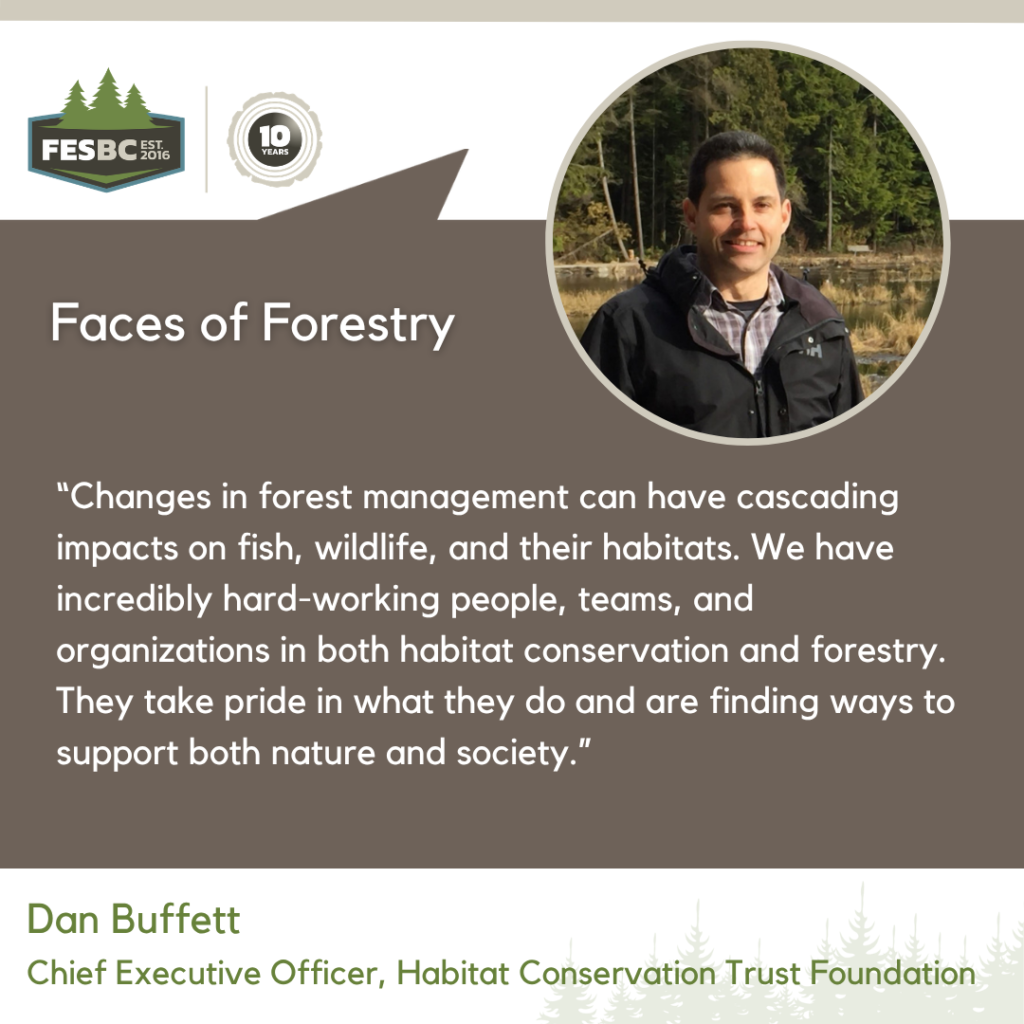
“Changes in forest management can have cascading impacts on fish, wildlife, and their habitats,” he said. “We have incredibly hard-working people, teams, and organizations in both habitat conservation and forestry. They take pride in what they do and are finding ways to support both nature and society.”
Thank you, Dan, for your leadership and for supporting the collaborative work that helps better protect and sustain British Columbia’s forests, wildlife, and habitats for future generations