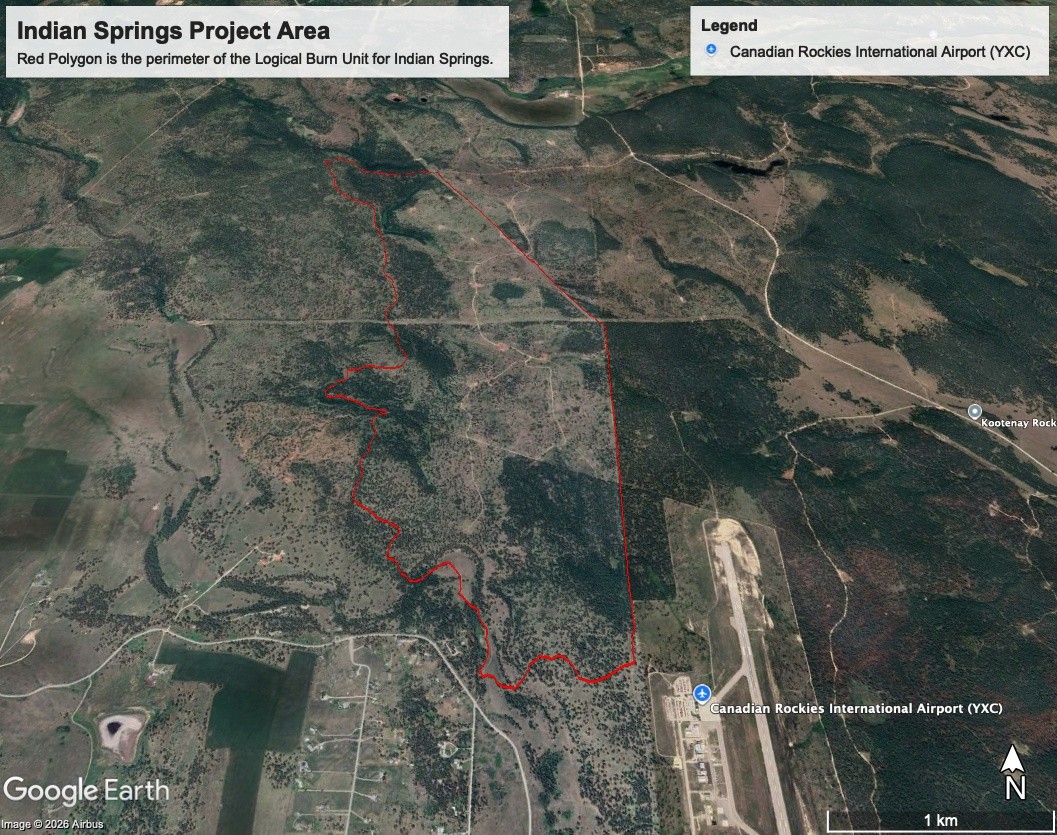
Photo: The Indian Springs Restoration Project area, outlined in red, is located north of Cranbrook near ʔaq̓am First Nation and the Canadian Rockies International Airport. The project contributes to broader landscape-level efforts to improve ecosystem health, wildlife habitat, and wildfire resilience.
Cranbrook, B.C. – Decades of fire suppression have changed the forests and grasslands of the East Kootenays. To address this issue, a collaborative ecosystem restoration project, north of Cranbrook is underway to restore a healthier, more resilient landscape while reducing wildfire risk. The Forest Enhancement Society of BC (FESBC), Rocky Mountain Trench Natural Resources Society (Trench Society), East Kootenay Invasive Species Council (EKISC), and other partners are working together on the Indian Springs Restoration Project, located beside the ʔaq̓am First Nation reserve and the Canadian Rockies International Airport.
Through manual thinning of trees to reduce forest fuels, intensive invasive plant management, and preparing for a future prescribed burn, the project is restoring open forests and grasslands historically maintained by frequent, low-intensity fire.
“This project will contribute to a landscape-level fuel break, which means creating a larger, connected area where forest fuels are reduced to help slow the spread and intensity of wildfire across the landscape,” said Travis Emsland, a Registered Professional Forester and Operations Manager with FESBC. “It ties into other ecosystem restoration treatment areas, as well as a nearby area that burned in a 2023 wildfire. The result will be a more open forest and grasslands that are better able to withstand wildfire while also providing improved habitats for wildlife. The project is also helping to address invasive plants to help support the overall health of the entire ecosystem.”
Before fire can safely be reintroduced on to the land, surface fuel accumulation and tree density reduction must be addressed. Current project work includes thinning trees, tree pruning to removing ladder fuels, pile burning, according to “Open Burning Smoke Control Regulation”, invasive plant management, and vegetation monitoring. Once these treatments are complete, a detailed burn plan can be developed in conjunction with the BC Wildfire Service. The goal is to create conditions suitable to support a prescribed burn, ideally as early as spring 2027, subject to approvals, funding, appropriate weather conditions, and optimal operational conditions.
For Marc Trudeau, a Registered Forest Technologist and the Executive Director of the Trench Society, the work is fulfilling because it is focused on restoring ecological processes that historically shaped the landscape.
“In ecosystems like Indian Springs, frequent low-intensity fires historically maintained open forests and grasslands. However, over many decades of fire suppression, trees have had the opportunity to grow closer together which has increased what we call ‘fuel loading’ and reduced habitat quality for wildlife such as deer, elk, owls, and many other species,” Trudeau said. “Our work is designed to mimic those natural processes of fire in a more controlled way.”
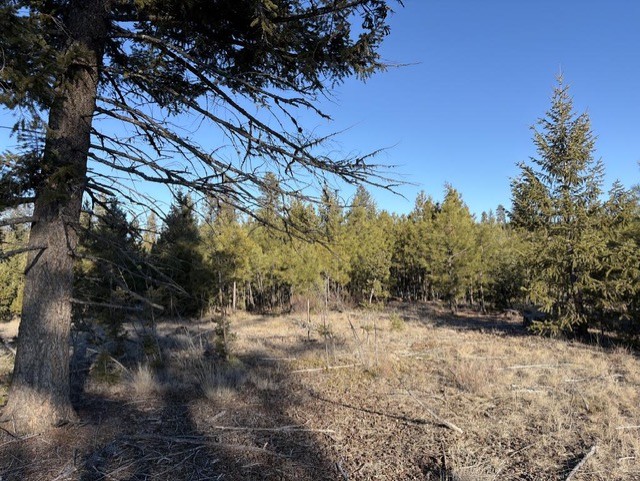
Photo: Dense tree ingrowth within the Indian Springs project area prior to restoration treatment. Reducing this growth will help restore the more open forest and grassland conditions historically maintained by frequent, low-intensity fire. Photo credit: Marc Trudeau
Scientific research is also informing the project. With support from Environment and Climate Change Canada’s Canada Nature Fund, the Trench Society has completed inventories for endangered American badgers, threatened Lewis’s woodpeckers, and Flammulated owls, a species of special concern. The information helps guide forestry planning and work to improve ecosystem health while helping better protect critical habitats.
“At the end of the project, I hope people will see a healthy, open landscape that more closely resembles what this ecosystem looked like before decades of fire suppression,” Trudeau shared. “Instead of crowded, dense stands of young trees, there will be more open forests with large, more mature trees, healthy grasslands, abundant wildlife trees, patches of shrubs that provide cover for wildlife, and productive winter forage for deer and elk.”
Managing invasive plants is another important consideration to restoring the area’s ecosystem. EKISC is working alongside the team to help identify and manage invasive species that can outcompete native vegetation, reduce biodiversity, and affect wildlife and livestock forage.
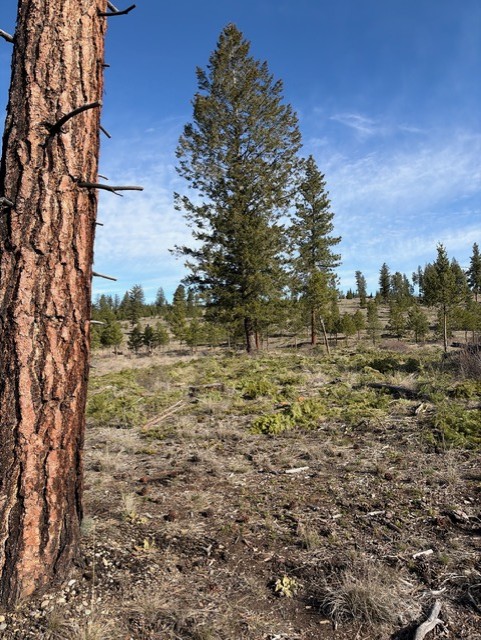
Photo: A treated area at Indian Springs shows the more open forest structure being restored across the project area. Mature trees are retained while smaller trees and forest fuels are reduced. Photo credit: Marc Trudeau
“By identifying and managing invasive species as part of restoration projects like Indian Springs, we are helping better protect native plant communities, improve wildlife habitat quality, and support healthier, more resilient ecosystems,” said Megan MacPhee, Program Assistant and Communication with EKISC.
The project itself is collaborative with many different participants including ʔaq̓am First Nation, FESBC, the Trench Society, EKISC, BC Wildfire Service, government agencies, range tenure holders, contractors, and community partners. The project has benefited from financial investments from FESBC, Environment and Climate Change Canada, the Canada Nature Fund, Columbia Basin Trust, and the Fish and Wildlife Compensation Program.
“It is incredible to see so many different areas of expertise come together to support meaningful restoration outcomes,” noted MacPhee. “Projects like Indian Springs demonstrate the importance of working together, combining restoration efforts and invasive species management, while utilizing local expertise to create lasting benefits for the East Kootenay landscape.”
For the Trench Society, which recently celebrated 30 years of ecosystem restoration and conservation work in the region, Indian Springs builds on decades of collaborative work.
“The Rocky Mountain Trench Natural Resources Society has a long history of delivering Ecosystem Restoration projects throughout the Rocky Mountain Trench, and we are grateful to have worked with many dedicated First Nation partners, government staff, stakeholders, and community organizations for decades,” shared Trudeau. “We are also very thankful for the funding support from FESBC and many others, which have allowed us to implement this important restoration work across southeastern British Columbia.”
The Indian Springs Restoration Project is demonstrating how coordinated investments in ecosystem restoration can achieve multiple outcomes on the same landscape. For Trudeau, MacPhee, and many others, the long-term vision is to maintain healthy open forests and grasslands, improve habitat for species at risk, support forage production, and create strategic fuel breaks around communities and infrastructure to provide better protection from potential wildfires.
“The Forest Enhancement Society of BC looks forward to continuing its work with the Trench Society to advance the shared goals of wildlife habitat enhancement, wildfire fuel mitigation, and more strategic community protection,” added Emsland. “All of these goals combined are part of the same effort to leave the landscape healthier and more resilient than it was before.”
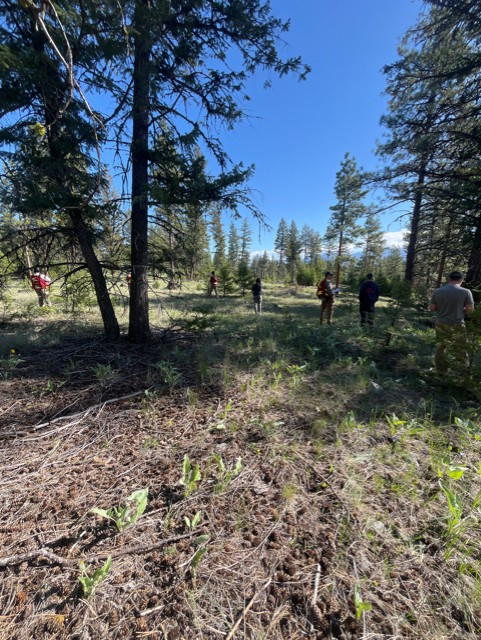
Photo: Project partners examine conditions within the Indian Springs Restoration Project area. Treatment planning considers forest fuels, ecosystem health, wildlife habitat, and other ecological values across the landscape. Photo credit: Marc Trudeau
For an interview with FESBC or the Rocky Mountain Trench Society, contact:
Aleece Laird, Communications Liaison, communications@fesbc.ca | 250.574.0221
About the Rocky Mountain Trench Society
The Rocky Mountain Trench Natural Resources Society supports ecosystem restoration across the East Kootenay and Columbia Valley, working collaboratively with government, First Nations, industry, non-governmental organizations and communities. Through the Rocky Mountain Trench Ecosystem Restoration Program, restoration efforts focus on recovering and maintaining low-elevation grasslands and open Ponderosa pine and Douglas-fir forests. This work helps improve wildlife habitat and biodiversity, support healthy native plant communities, enhance forest health and reduce the potential severity of wildfires. Restoration activities take place across Crown land, parks, private conservation lands, and First Nations reserves from Radium Hot Springs to the U.S. border. To learn more about the Ecosystem Restoration Program, visit the program website: www.trench-er.com
About the Forest Enhancement Society of BC
The Forest Enhancement Society of BC (FESBC) invests in projects that enhance the health and resilience of British Columbia’s forests for the benefit of communities, wildlife and the environment. Working with First Nations, communities, government agencies, tenure holders and organizations such as the Rocky Mountain Trench Natural Resources Society, FESBC supports locally led projects that reduce wildfire risk, improve wildlife habitat, restore and improve forests, and make better use of forest fibre. In the East Kootenays, this collaborative approach helps advance ecosystem restoration projects that bring together local knowledge, technical expertise, and funding to achieve multiple benefits on the landscape. To learn more about FESBC, visit: www.fesbc.ca or follow FESBC on social media: Linked In, Facebook, Bluesky, and sign up for the monthly newsletter.