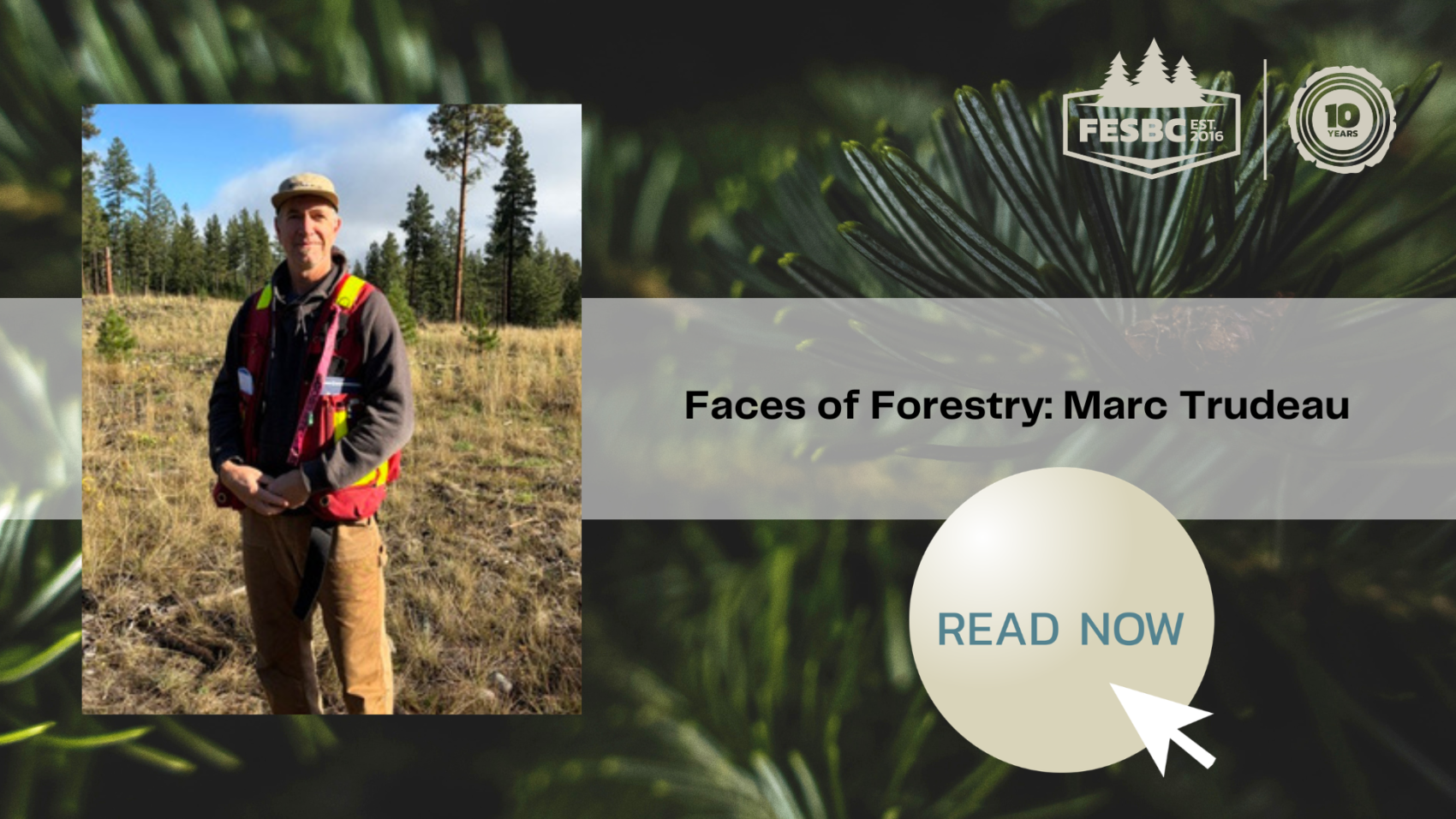
Faces of Forestry is an initiative of the Forest Enhancement Society of BC (FESBC) to highlight people doing meaningful work to support healthy and resilient forests across British Columbia (B.C.). This month, we feature Marc Trudeau, Executive Director of the Rocky Mountain Trench Natural Resources Society (Trench Society), a coalition of nine ranching, hunting, environmental, and wildlife organizations working together to restore and conserve the grasslands and open forests of the southeast Kootenays.
As someone who has always enjoyed working in the outdoors and spending time in wild places, Marc naturally gravitated toward a career in forestry. His experience working as a tree planter gave him insight into how forests were managed on a larger scale and sparked his curiosity around the science and management behind forested landscapes. “The more I learned, the more interested I became in finding ways to sustainably manage and restore forest ecosystems for future generations,” he said.
Marc’s post-secondary education gave him a strong background in forest ecology and land management. He completed his diploma in Integrated Forest Management from Lakehead University in Ontario and is now a Registered Forest Technologist with Forest Professionals BC. “Over the years, I’ve built on my education through hands-on experience managing ecosystem restoration projects and working with a wide range of partners across southeastern British Columbia,” he added.
As Executive Director of the Trench Society, Marc coordinates, administers, and manages ecosystem restoration projects throughout southeastern B.C., primarily within ecosystems that are historically characterized by frequent, low to medium intensity fires that maintain open canopy forests or grasslands.
On a day-to-day basis, Marc works with a wide range of people and groups, including First Nations, range tenure holders, government agencies, funders, contractors, and community partners, to deliver meaningful ecosystem restoration projects in the Rocky Mountain Forest District. This involves meetings, site visits, consultation and engagement, fundraising, contract administration, supervision, organizational management, reporting, and collaboration with partners and the public.
Marc has been involved with FESBC through the development and delivery of ecosystem restoration and wildfire risk reduction projects that align with their funding priorities. He works with FESBC-funded projects from proposal development and funding applications through to project implementation, reporting, and monitoring.
One such project is a more than 600-hectare ecosystem restoration initiative located adjacent to the ʔaq̓am First Nation community and the Canadian Rockies International Airport.
“Over the past five years, we have completed a series of complementary treatments, including thinning trees by hand, creating wildlife trees for birds, bats, and other small mammals, vegetation monitoring, invasive plant management, species-at-risk surveys, and range infrastructure improvements,” Marc explained. “These activities work in unison to prepare the site for a prescribed burn planned for the spring of 2027.”
FESBC funding helps support several components of this project, which will improve open forest and grassland ecosystems while significantly reducing wildfire risk to nearby residences, the ʔaq̓am community, and critical infrastructure such as the Canadian Rockies International Airport.
For Marc, the most enjoyable part of his career is the opportunity to work with a wide range of people who bring different perspectives to the work. From chainsaw operators and habitat biologists to Indigenous Guardians, the variety of individuals he works with each day keeps the work engaging, meaningful, and constantly evolving.
One thing that Marc would like people to understand about forestry is that forest ecosystems are highly dynamic and complex, and they require thoughtful, adaptive management rather than one-size-fits-all approaches. As forests are constantly changing through natural disturbance, climate influences, and human activity, the decisions about how they are managed must account for multiple ecological and social values over time.
“From my experience working in ecosystem restoration, I’ve seen how important it is to balance objectives such as biodiversity, wildfire risk reduction, wildlife habitat conservation, and economic use,” he said. “Good forestry is about working with that complexity in a careful and informed way, rather than trying to simplify it.”
Marc is proud to work with the Trench Society which is commemorating its 30th anniversary, celebrating the long-standing commitment of many partners, funders, and organizations who have contributed to ecosystem restoration work in the region over that time. He values being part of a field where collaboration, traditional knowledge, science, and stewardship come together to improve both ecosystem health and community resilience.
He is also very grateful for the opportunity to work with a dedicated group of people and to contribute to projects that have real, on-the-ground impact in southeastern B.C. He looks forward to continuing to build on this work and contribute to the next phase of restoration efforts in the area.
Thank you, Marc, for your leadership, passion, and commitment to shaping a bright future for the health and resiliency of forests in B.C.