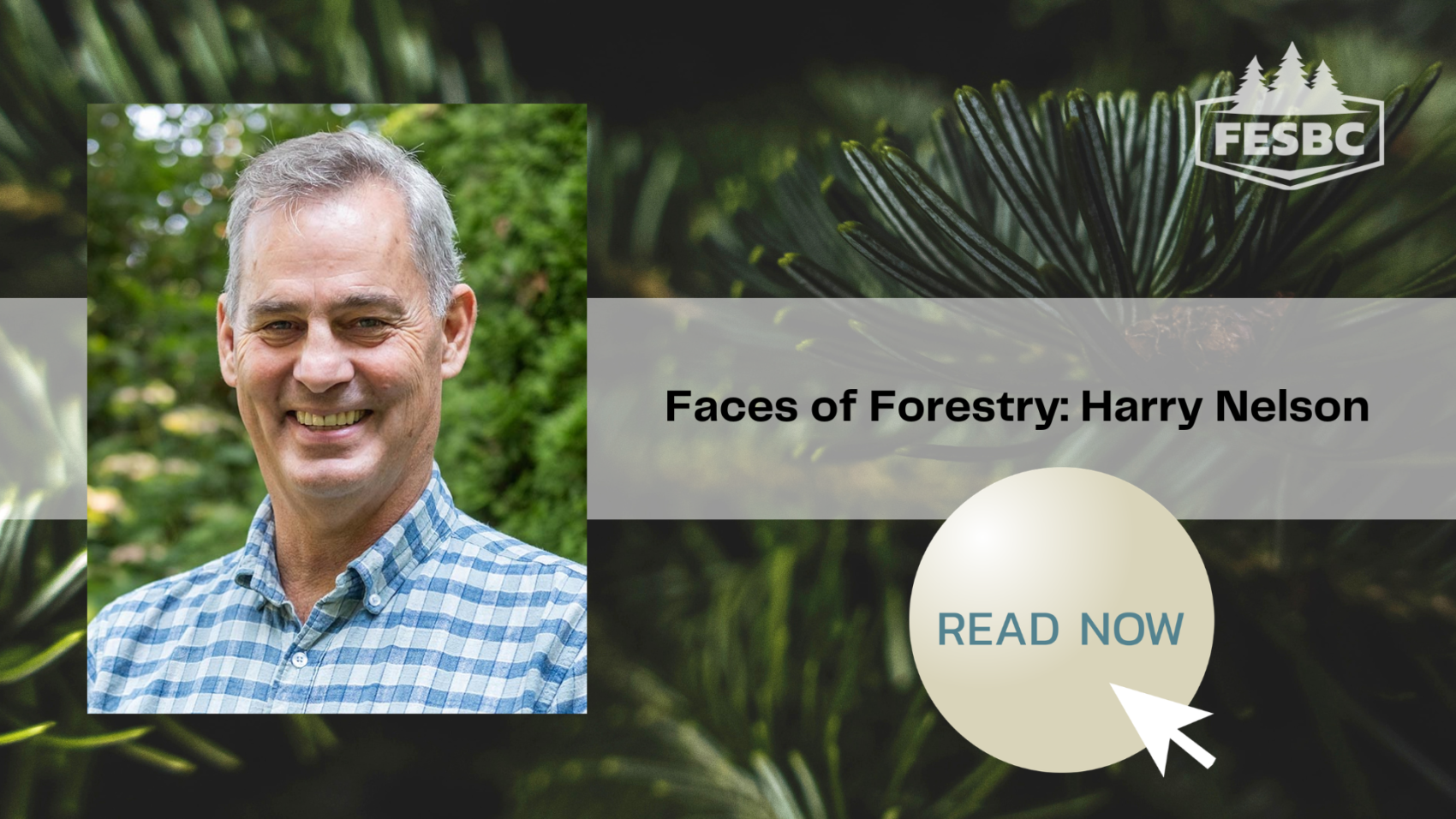
Faces of Forestry is an initiative of the Forest Enhancement Society of BC (FESBC) to highlight people doing meaningful work to support healthy and resilient forests across British Columbia (B.C.). This month, we feature Harry Nelson, Professor in the Faculty of Forestry and Environmental Stewardship (FES) at the University of British Columbia (UBC) in Vancouver, B.C.
Harry’s decision to pursue a career in forestry stemmed from an interest in how environmental and resource policies are organized, which developed over the course of his post-secondary education. After completing his undergraduate degree at Carleton College, and his Master’s in Public Policy from Harvard Kennedy School, he went on to complete his Master’s in Economics at UBC.
“When I ended up at UBC, I became interested in forestry, given not only its importance, but also because it touched so many aspects of other policies in the province, creating many fascinating research opportunities,” Harry explained. “I saw economics as the most useful way to examine public policy, which eventually culminated in a PhD in Forest Economics at UBC.”
Early in his forestry career, Harry became involved in the softwood lumber dispute in the 1990s, an experience that introduced him to both the complexity of B.C.’s forest sector and the challenges of developing policy that reflects its many different interests.
He saw government and industry mobilize to address trade challenges, while also seeing the differences between the Coast and Interior, major and independent operators, and primary and value-added producers. One of his key takeaways was the importance of having a robust policy framework around the economics of the sector to help manage and balance these different interests.
The experience also shaped Harry’s perspective on trade policy. He observed how trade restrictions became increasingly institutionalized over time and felt that too much attention was sometimes placed on determining what changes would be politically palatable to the U.S., rather than identifying what made the most sense for B.C.
Today, Harry’s areas of research and teaching include Forest Policy, as well as Forest and Resource Economics. He is currently working on a research proposal for a project that will examine what is known about forest conflict, what its impacts might be, and how it can be resolved in a constructive way.
He also teaches a fourth-year class on Forest Policy for undergraduate students, within the Masters of Sustainable Forest Management (MSFM) program within the FES department, as well as the Forest Economics course for the program. His research may also involve working with graduate students conducting their own studies, which can sometimes contribute to his research.
Harry has often looked to FESBC for data for research projects and insights into what is actively happening on the ground. He noted that FESBC is unique as they work across all areas of the province and are willing to share their operational experience, which is invaluable in understanding something as complex as how forest policy may be working, or what may need improvement.
Harry’s connection to forests and landscapes also extends beyond his professional career. His family has a home just outside of Hinton, Alberta, in the Athabasca River valley in the foothills east of Jasper, where he spent his childhood summers. The experience was formative, giving him a lasting appreciation for the connection people can have to the land and landscapes around them.
Today, that connection also gives Harry a long-term perspective on how forests and communities change. Through family stories and photographs spanning nearly 100 years, he has seen the history of the area and how its landscape has evolved, from the days of outfitters and trappers before forestry arrived in the area in the 1960s to current efforts to reduce wildfire risk around Hinton.
The highlights of Harry’s career have always been the people, communities, and landscapes that he gets the opportunity to visit in B.C. and beyond. “I consistently find people that are trying to solve problems and care about the people and places around them; supporting them in this work is crucial,” Harry said. “This is especially the case where there are several competing voices and ideas, and one of the challenges is cutting through that clutter to identify what makes sense.”
Thank you, Harry, for your amazing contributions to shaping the next generation of forestry professionals.