Williams Lake, B.C. – Central Chilcotin Rehabilitation Ltd. (CCR), a joint venture company owned by the Tŝideldel First Nation, the Tl’etinqox Government and the Yunesit’in Government, has been implementing large-scale, Indigenous-led forest management programs and initiatives within their communities for nearly a decade. Recently, with funding support from the Forest Enhancement Society of BC (FESBC), CCR has expanded its forest rehabilitation work, delivering innovative treatments that are making local forests in the Chilcotin more resilient to climate change and losses from wildfires. A project of note is a fire salvage and ecosystem restoration project called “the Palmer project”, located along Palmer Lake Road in the Cariboo Chilcotin in an area heavily impacted by wildfires in 2017.
“We want to leave behind a legacy, a resilient forest that not only sustains our people but supports wildlife and future generations,” shared Percy Guichon, CEO of CCR and an elected Councilor of Tŝideldel First Nation. “We’re helping Mother Nature recover, and we are showing what is possible when Indigenous communities take the lead in the planning and the implementation of the work.”
One of the largest rehabilitation projects in our province’s history
Over eight years after the devastating 2017 Plateau wildfire, the objectives of the Palmer project sought to address some of the large scale, post-wildfire challenges. CCR applied some of the lessons learned from its previous experience reclaiming damaged stands in the Pressy Lake area to treat or remove the fire killed trees in the Palmer Lake area.
“The Palmer project is defined by vast, contiguous areas of fire-killed pine that historically, have never been salvaged,” explained Daniel Persson, Registered Professional Forester (RPF) and CCR’s Forestry Superintendent. “From the outset, our focus was on finding innovative ways to utilize this stranded fibre resource, turning what is currently a liability on the landscape into long-term economic opportunity. If we can solve the operational and economic challenges of recovering and using this material, it has the potential to create sustained employment and predictable forestry work for CCR partner communities for many years.”
The Palmer project focuses on treating extensive burned lodgepole pine stands. Recovering and utilizing fire-damaged fibre at sufficient volumes was essential to making the treatment economically viable while supporting rehabilitation objectives. At the same time, addressing fuel loading (or the burnable materials) at this scale across the landscape presented a significant opportunity to implement landscape-level fire management strategies, expanding defensibility, reducing reburn potential, and influencing how future wildfire interacts with the broader land base.
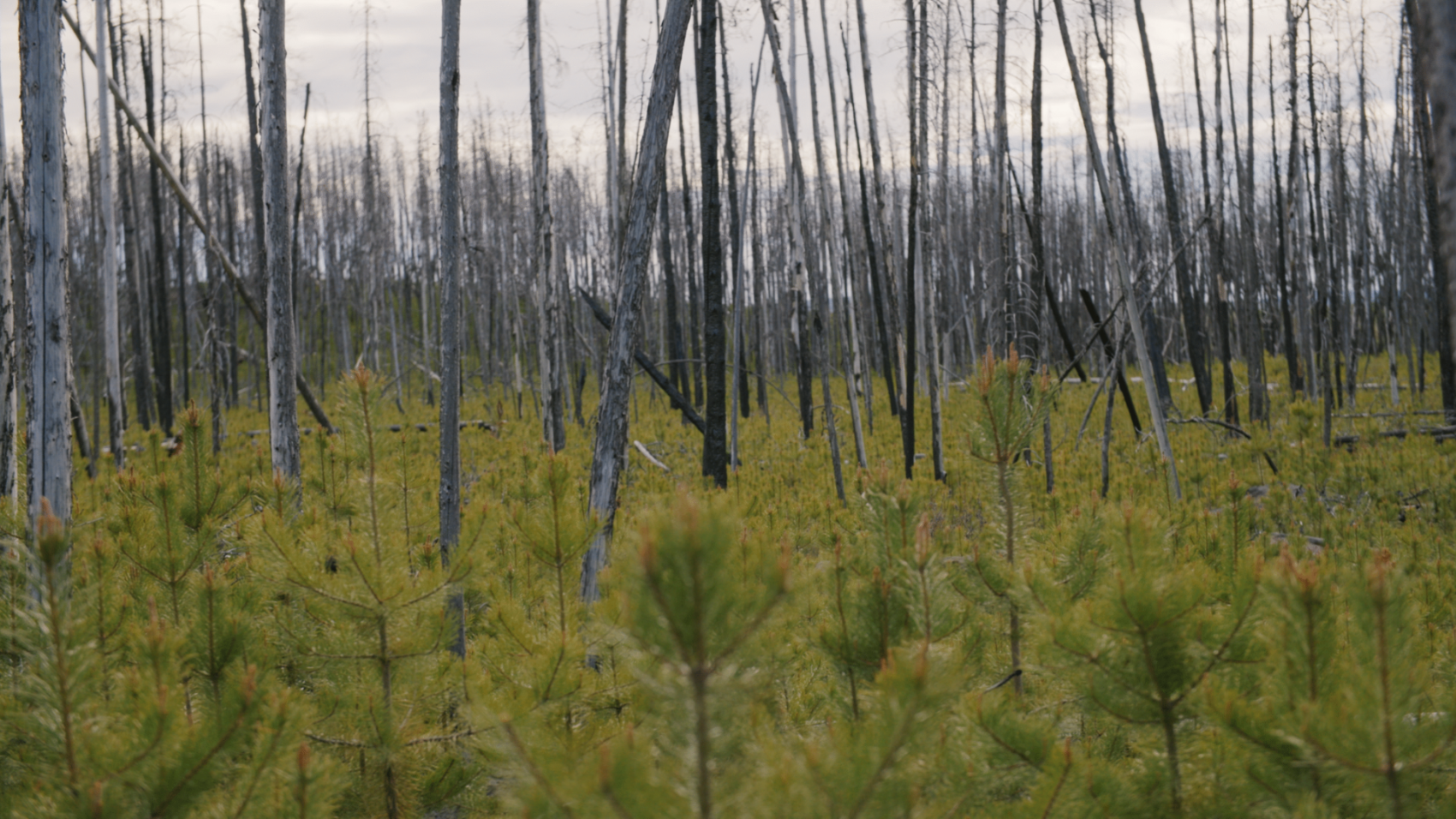
The project spans a large, remote wildfire footprint where fibre demand and economics have historically limited recovery. When field operations began in fall 2024, stands were in extremely poor condition, with roughly 1,200 to 1,600 dead pine stems per hectare remaining. Beneath this overstory (or the upper layer of vegetation in a forest), dense post-fire regeneration, often exceeding 75,000 stems per hectare, created severe competition between young trees, limiting growing space and constraining the forest’s ability to transition into a healthy, resilient future stand without intervention.
“These burned pine stands are often left untreated after a fire. As the overstory falls, areas in the Chilcotin continue to accumulate fuels, creating a significant density of dead trees and woody debris that can persist for decades,” shared Michael Tomlinson, RPF, General Manager, Consus Management Ltd. “Given the slow decomposition rates of burnt trees in the West, driven by limited moisture, fire behaviour and the duration of wildfire risk remain significant over time.”
To reduce these risks, CCR used standard logging equipment. The approach helped thin or selectively remove some of the overcrowded young trees while making use of the local contractors existing logging equipment.
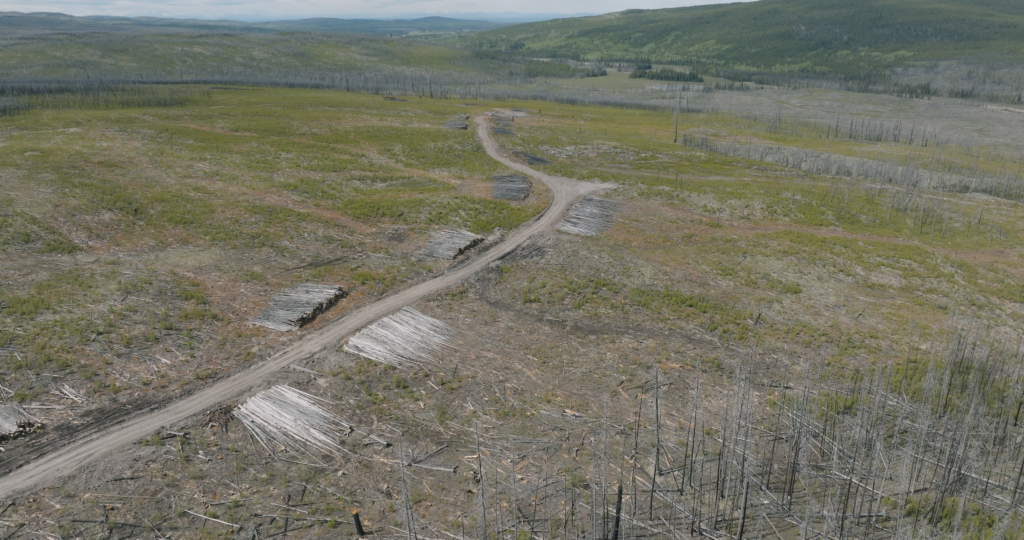 Wood has already been bunched and skidded – it is ready for loading. Photo Credits: CCR.
“Over time, standing burnt stems fall over and create fuel that lies horizontally on the ground. If another wildfire moves through the area, this fuel can burn much hotter, damaging the soil and killing the new crop of trees beneath the top layer of the forest,” said Brian Watson, RPF, Operations Manager with FESBC. “By removing these burnt standing trees before they fall, the risk of severe future wildfires is reduced, serving to protect the forests at a stand and landscape level.”
CCR’s approach focuses on changing wildfire behaviour by manipulating both its path and its intensity as it moves through the landscape.
“By breaking up the continuity of fuels and dense regeneration, we can reduce fire intensity and manipulate the wildfire interaction with the landscape, creating conditions that support suppression efforts,” said Tomlinson. “When integrated with existing road infrastructure, natural fuel breaks, and vulnerable terrain features, such as steep or wind-driven valleys, south and west facing slopes, and large protected areas, these treated areas can function as effective anchor points for wildfire response.”
As a result, treated areas are expected to burn at lower intensities, increasing post-fire survival and supporting long-term forest recovery.
Outcomes the Nations and funders are proud of
To date, the team at CCR has already seen major improvements to the land. Currently, more than 1,500 hectares have been rehabilitated and around 200,000 cubic metres of wood fibre have been recovered from both Pressy Lake and Palmer projects. The wood fibre from burnt trees has been transported either to pulp mills or bioenergy facilities, supporting these operations at a time of scarcity of wood fibre.
The Palmer project, as a secondary outcome, has delivered significant socio-economic benefits to remote First Nations communities in the Cariboo Chilcotin.
“The project has supported Nation-led employment and generated roughly $14 million in product revenue that flows directly back into jobs. Overall, this equates to about 45 people working full-time for one year across operations, forestry, supervision and administration,” said Persson.
CCR and its partners see the Palmer project as a model that can be adapted to other fire-affected regions across Northern and Southern B.C., where similar conditions exist.
“The Palmer project illustrates how existing approaches to silviculture responsibility do not always align with the conditions of fire-affected forests, which in many cases function more as a public risk than a future timber asset. We are hopeful that this project can help inform and guide similar initiatives in other areas with comparable fire histories,” noted Tomlinson.
As the Palmer project continues, CCR and its partners, remain focused on creating resiliency in the region.
“Partnerships like this one enable high-impact projects that not only recover lost value but also help shape a more sustainable future,” noted Watson. “This project directly supports our mandate to help mitigate wildfire risk to help better protect communities, to enable the forest ecosystems to become more resilient to climate change, and to further rehabilitate forest ecosystems to support a sustainable land-base for timber harvesting.”
Ravi Parmar, Minister of Forests recognizes the Palmer project as an investment in more resilient forests while reflecting Indigenous-led stewardship and good forest management.
“The Palmer Project is moving local logs to local mills, creating good paying jobs out of fire-damaged timber,” said Ravi Parmar, Minister of Forests. “This First Nations-led project is rehabilitating the trees, developing long-term forest health and wildfire resilience. We’re proud to fund the expansion of one of the most significant rehabilitation projects in BC’s history.”
This is what the future of forestry looks like
As highlighted by CCR during its presentation at the Forest Professionals BC conference in February 2026, the extensive buildup of dead fuel across forests in the Interior of the province, driven by mountain pine beetle impacts and wildfire damage, represents one of the greatest threats to long-term forest resiliency. Without intervention, these conditions significantly increase the likelihood of catastrophic, high-intensity wildfires that can permanently damage soils, ecosystems, and nearby communities.
Projects like the Palmer Lake initiative demonstrate how proactive, large-scale rehabilitation can reduce future wildfire risk, improve forest health, and restore value to landscapes that might otherwise be written off. This work showcases the value of collaboration when Indigenous leadership, experienced foresters, and targeted investment come together in British Columbia.
Watch a video of CRR’s Palmer Project: https://youtu.be/GP5J6dkx2-Y?si=yaOyYyijtDupmFmD
For More Information or to Book and Interview with FESBC or CCR, contact:
Valeria Molina, Communications Liaison, valeria@amplifyinc.ca | 250.879.3006
About the Forest Enhancement Society of BC: The purposes of FESBC are to advance environmental and resource stewardship of B.C.’s forests by – preventing and mitigating the impact of wildfires; improving damaged or low-value forests; improving habitat for wildlife; supporting the use of fibre from damaged and low-value forests; and treating forests to improve the management of greenhouse gases. FESBC has been granted millions of dollars in funding from the government of B.C. to support hundreds of projects, to date, throughout the province.
Follow FESBC on social media: LinkedIn | Facebook | BlueSky Subscribe to FESBC’s monthly newsletter
About CCR: Central Chilcotin Rehabilitation is a joint venture of Tŝideldel First Nation, Tl’etinqox Government, and Yunesit’in Government. The joint venture was originally formed to address the 100,000 hectares of dead pine left in the Chilcotin region and to rehabilitate those stands into productive forests. The fires in the summer of 2017 amplified the need to address heavily burned forest stands with minimal economic value. CCR’s mission is to coordinate and implement large-scale forestry programs and initiatives within the traditional territories of the Tŝideldel First Nation, Tl’etinqox Government and Yunesit’in Government, generating economic, social, and environmental benefits. For more information: www.centralcr.ca
Follow CCR on social media: LinkedIn | Twitter/X | Facebook
FESBC would like to gratefully acknowledge the financial support of the Province of British Columbia through the Ministry of Forests.