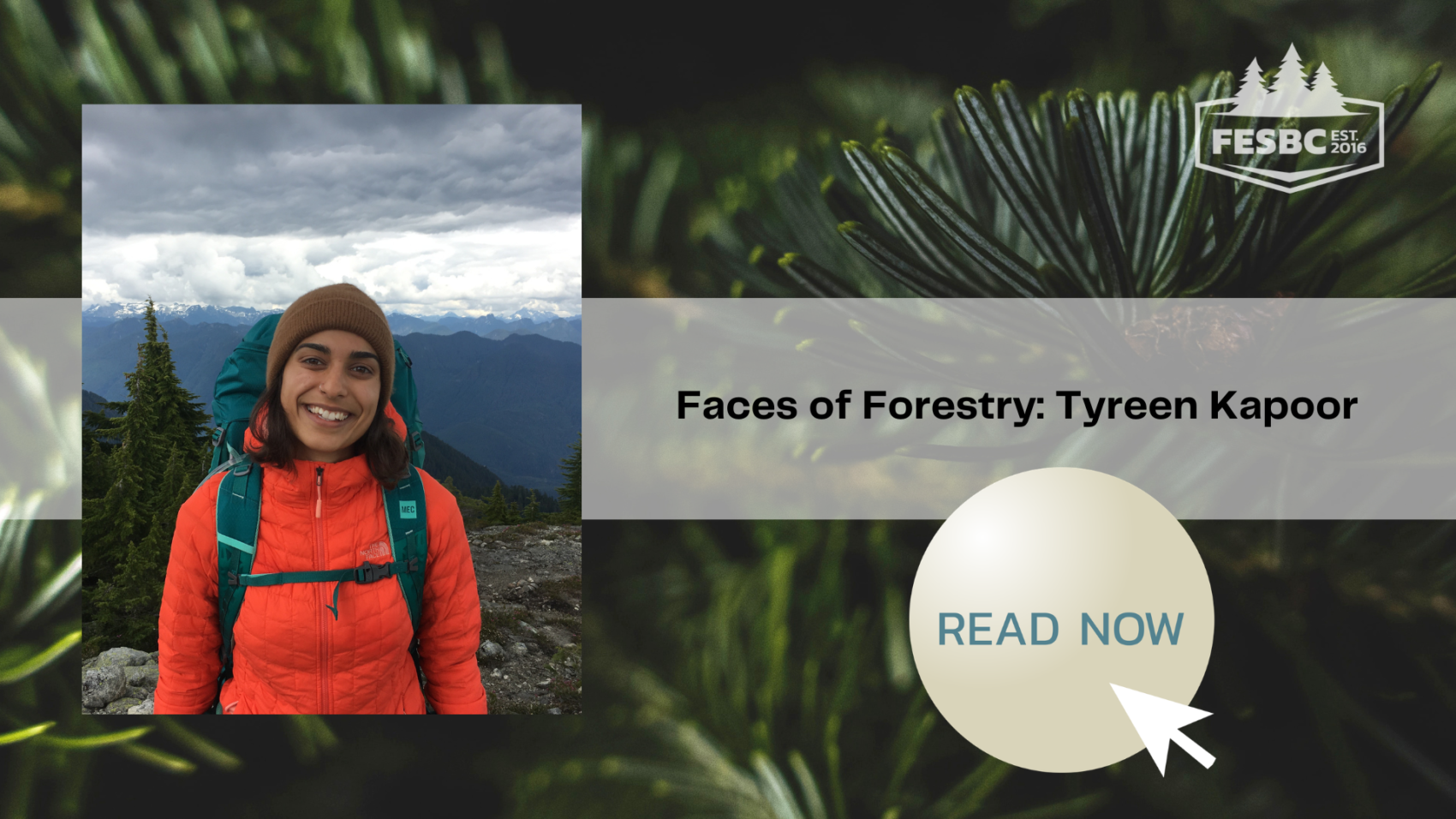
Faces of Forestry is an initiative of the Forest Enhancement Society of British Columbia (FESBC) to highlight people doing meaningful work to support healthy and resilient forests across British Columbia. This month, we feature Tyreen Kapoor, Data Curation Specialist for the Silviculture Innovation Program (SIP), led by the Bulkley Valley Research Centre. Through her work, she helps make forestry knowledge easier to find, understand, and use for people working in the sector across B.C.
Tyreen completed her Bachelor of Science in Environmental Sciences at the University of British Columbia and later earned a Master of Science degree from Carleton University. During her studies, she realized that while she enjoyed the natural sciences, she was especially drawn to the social side of environmental work.
“I knew I wanted to do something that combined my interest in natural science with social science,” she said. “Through science and education-focused work experiences, I became really interested in how scientific knowledge is shared and how it can actually be used in practice.”
This interest shaped her master’s research, which focused on knowledge exchange and on how research and evidence can move more effectively into real-world decision-making in the forestry sector. Through this work, she learned about the role of knowledge brokers; people who help connect those who generate knowledge to those who apply it.
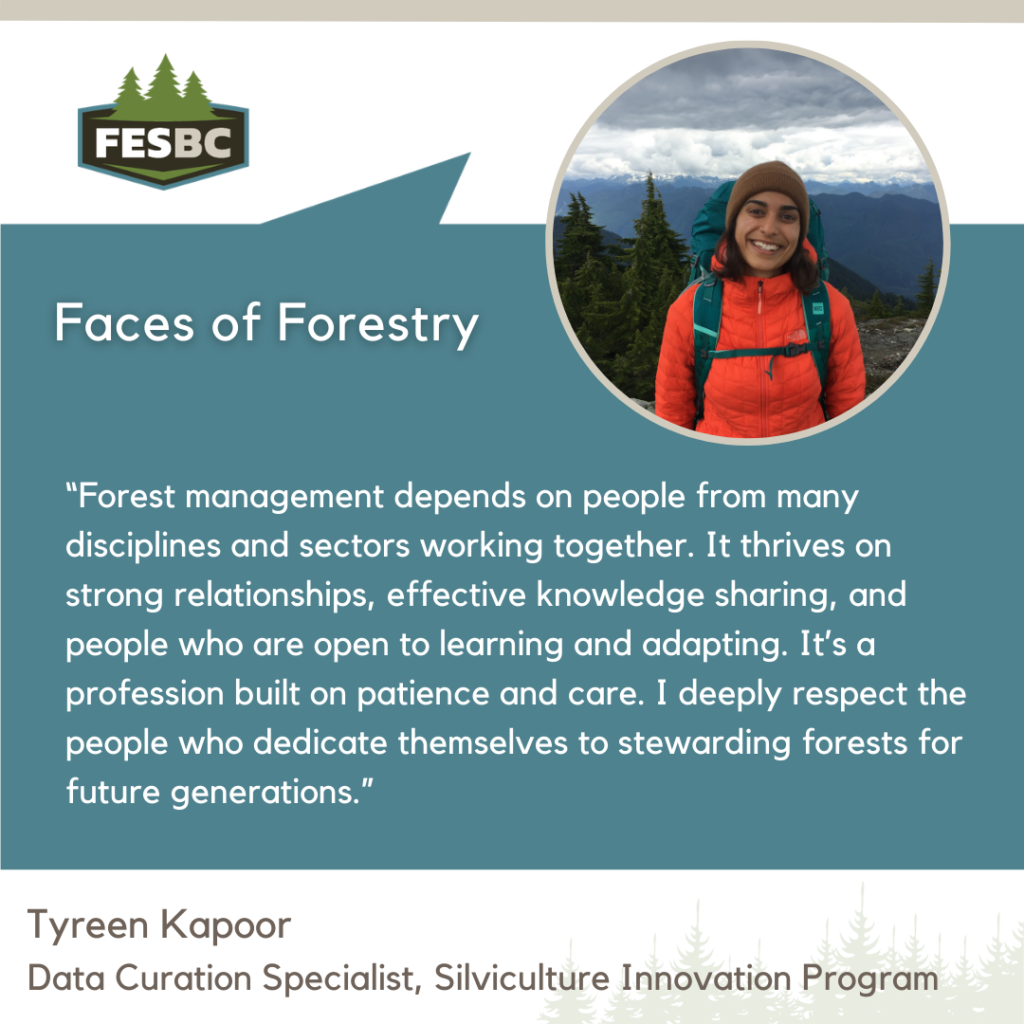
In her role, Tyreen focuses on gathering and organizing information that supports innovative silviculture.
“The role of Data Curation Specialist really stood out to me because it allows me to act as a kind of knowledge broker,” she said. “I get to help bridge the gap between knowledge and action by curating resources that forestry practitioners can access, adapt, or apply in their work.”
In October 2025, the Silviculture Innovation Program Exchange (SIPex) resource library, an online space designed to share practical knowledge with forestry practitioners, was launched. Currently, Tyreen plays a key role in supporting the platform by building and maintaining the resource library.
“I do the important work of collecting, curating and tagging materials so they can be added to the SIPex resource library,” she explained. “This library hosts resources that help extend knowledge and improve access to information on innovative silviculture in British Columbia.”
The library includes a wide range of materials, including case studies, guidance documents, webinars, podcasts, and other learning tools, that support decision-making on innovative silviculture.
“The resource library is a carefully curated collection of knowledge that directly supports planning and implementation,” she explained. “It’s meant to be a place where practitioners can learn more, no matter what stage of work or in a project they’re at.”
Beyond working behind-the-scenes to support the library, Tyreen also helps curate training and education resources that support skills development and learning opportunities. She works with subject-matter experts to develop featured topics that guide users through specific areas of interest. One of the first featured topics focused on ‘Fire and Forestry’ with more topics planned for the future.
Tyreen also sees connection as an important part of forestry knowledge. SIPex includes tools that help users find experts and connect with communities of practice, recognizing that learning often happens through relationships and shared experience.
“Knowledge that supports forest stewardship is often collaborative and experiential,” she said. “SIPex helps connect people to information, but also to each other.”
What Tyreen enjoys most about her work is knowing that it helps support people who are making decisions that shape the future of forests.
“I love that my work helps empower forestry practitioners to make informed decisions,” she said. “That means considering research, practical experience, Indigenous knowledge, and different management goals.”
She values being able to bring these perspectives together and to help reflect the complexity of forest management in British Columbia.
“I feel lucky to help create a space where people can learn, collaborate, and adapt. That kind of learning is essential for building more resilient forests and a more innovative forestry sector,” she added.
For Tyreen, forestry is a long-term commitment in which collaboration is a key to success.
“Forest management depends on people from many disciplines and sectors working together,” she said. “It thrives on strong relationships, effective knowledge sharing, and people who are open to learning and adapting. It’s a profession built on patience and care. I deeply respect the people who dedicate themselves to stewarding forests for future generations.”
Thank you Tyreen, for your work in strengthening knowledge sharing and supporting informed, collaborative, and innovative forest stewardship across British Columbia.