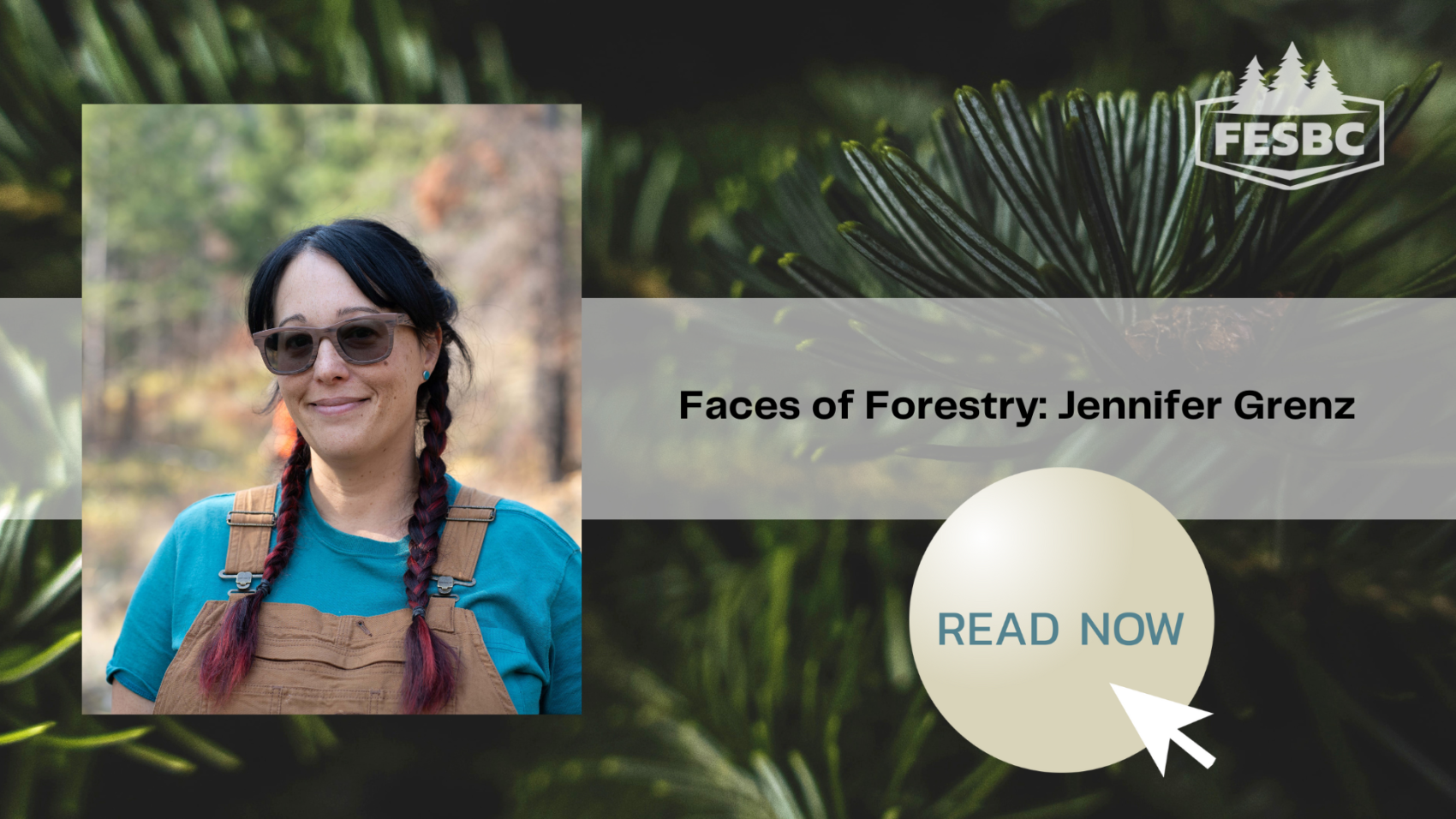
Faces of Forestry is an initiative of the Forest Enhancement Society of BC (FESBC) to highlight people doing great work to enhance our forests throughout British Columbia. This month, we feature Jennifer Grenz, Assistant Professor and Indigenous Scholar in the Department of Forest Resources Management at the University of British Columbia (UBC), jointly appointed between the Faculty of Forestry and the Faculty of Land and Food Systems, and member of the Lytton First Nation.
Jennifer holds a Bachelor of Science in Agroecology and a PhD in Integrated Studies in Land and Food Systems, both from UBC.
“I grew up with a deep love for our lands and waters, so a career in restoration ecology was likely inevitable for me,” she shared. “I love the opportunity to problem-solve how to heal land from a relational worldview in a wide variety of contexts. I enjoy thinking about how we can strengthen human relationships with forests and how that can improve forest resiliency.”
Prior to her academic appointment almost four years ago, she worked for several environmental non-profit organizations and ran her own invasive plant management company that worked with government agencies and forestry companies.
Beyond her role as an Assistant Professor and Indigenous Scholar, Jennifer is also the current Principal Investigator of the Indigenous Ecology Lab. Her lab works in nine different Indigenous communities across the province, and projects vary depending on the land-healing needs of those communities, every day brings something different.
“Our research is highly interdisciplinary focused on bringing together critical aspects of restoration ecology, such as soil microbial ecology to improve the efficacy of invasive plant management and the establishment of native plants, spatial dynamics of native and invasive plants on post-wildfire landscapes, and native seed ecophysiology, or studies of how a plant physiological processes are affected by their environment,” she explained.
As most of the work is community-based, Jennifer’s team works to Indigenize methodological approaches, such as grounding them in deep knowledge of historical ecology and traditional stewardship practices, plus applying Western scientific methodologies while using cultural plant classifications in vegetation analyses.
“We work in a variety of settings, such as post-wildfire landscapes, and the reclamation and revitalization of historic Indigenous food systems. I am lucky enough to mentor nine amazing graduate students, and support the research led by the communities with whom we are working,” she added.
For Jennifer, it is essential that people recognize that forest enhancement and utilization can coexist when guided by Indigenous knowledge.
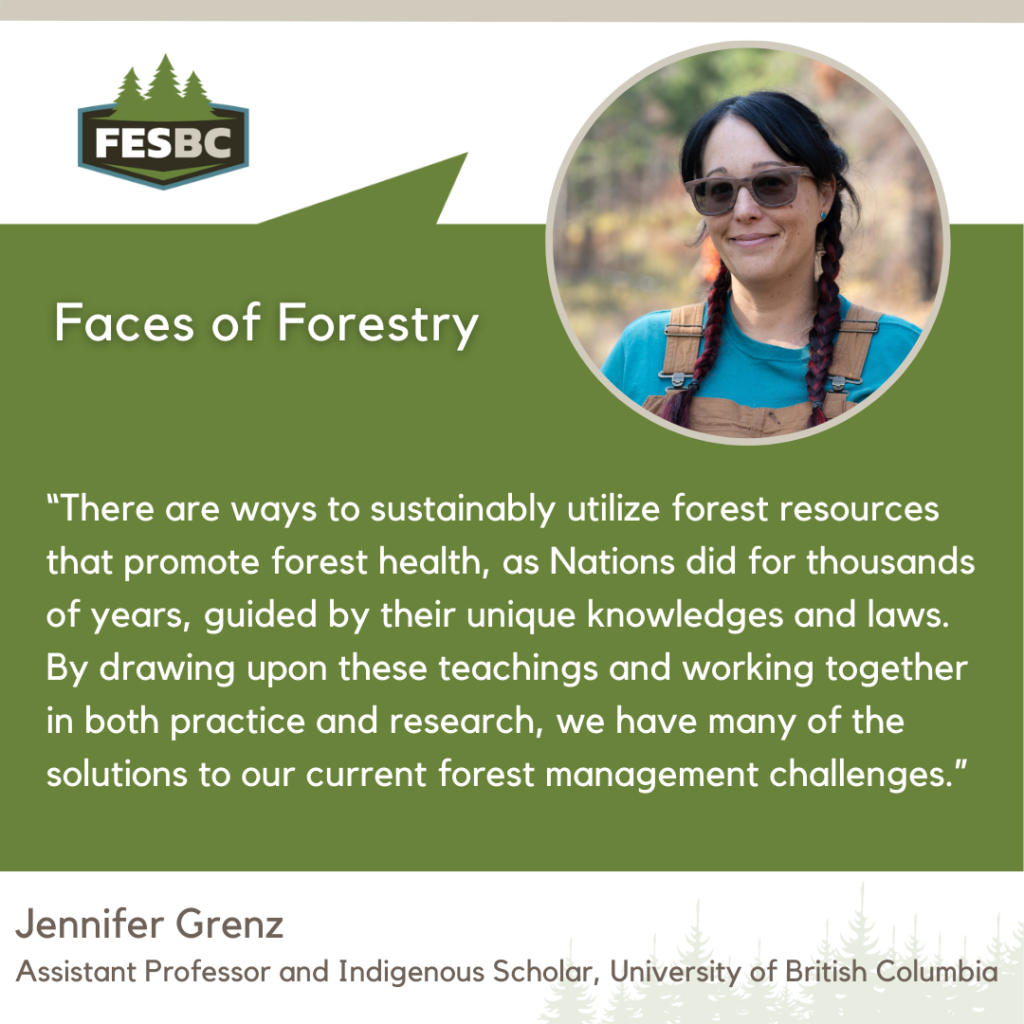
“There are ways to sustainably utilize forest resources that promote forest health, as Nations did for thousands of years, guided by their unique knowledges and laws. By drawing upon these teachings and working together in both practice and research, we have many of the solutions to our current forest management challenges,” she said.
This approach aligns with FESBC’s mission to invest in projects that create healthy and more resilient forests for generations, which in turn help communities take action on climate change, increase First Nations participation in the forest economy, and help create good, family-supporting jobs.
Jennifer’s passion for this work is deeply rooted in her identity as an Indigenous scholar.
“My Elders have taught me, ‘if we don’t use the plants, we will lose them’. I believe the work we are doing is so crucial as it centres the reclamation and revitalization of Indigenous stewardship practices and aligns with a fundamental law from my Nlaka’pamux Nation—ʔeskʷen̓ste e tmixʷ ʔe k skʷen̓stc heʔwi— you take care of the land, and the land will take care of you,” she noted.
Looking forward, she is committed to the co-production of research focused on a healthy, reciprocal relationships, such that we can ensure healthy forests for future generations of all relations.
Thank you, Jennifer, for your inspiring work and your commitment to fostering a future where forest enhancement and cultural revitalization grow hand in hand.