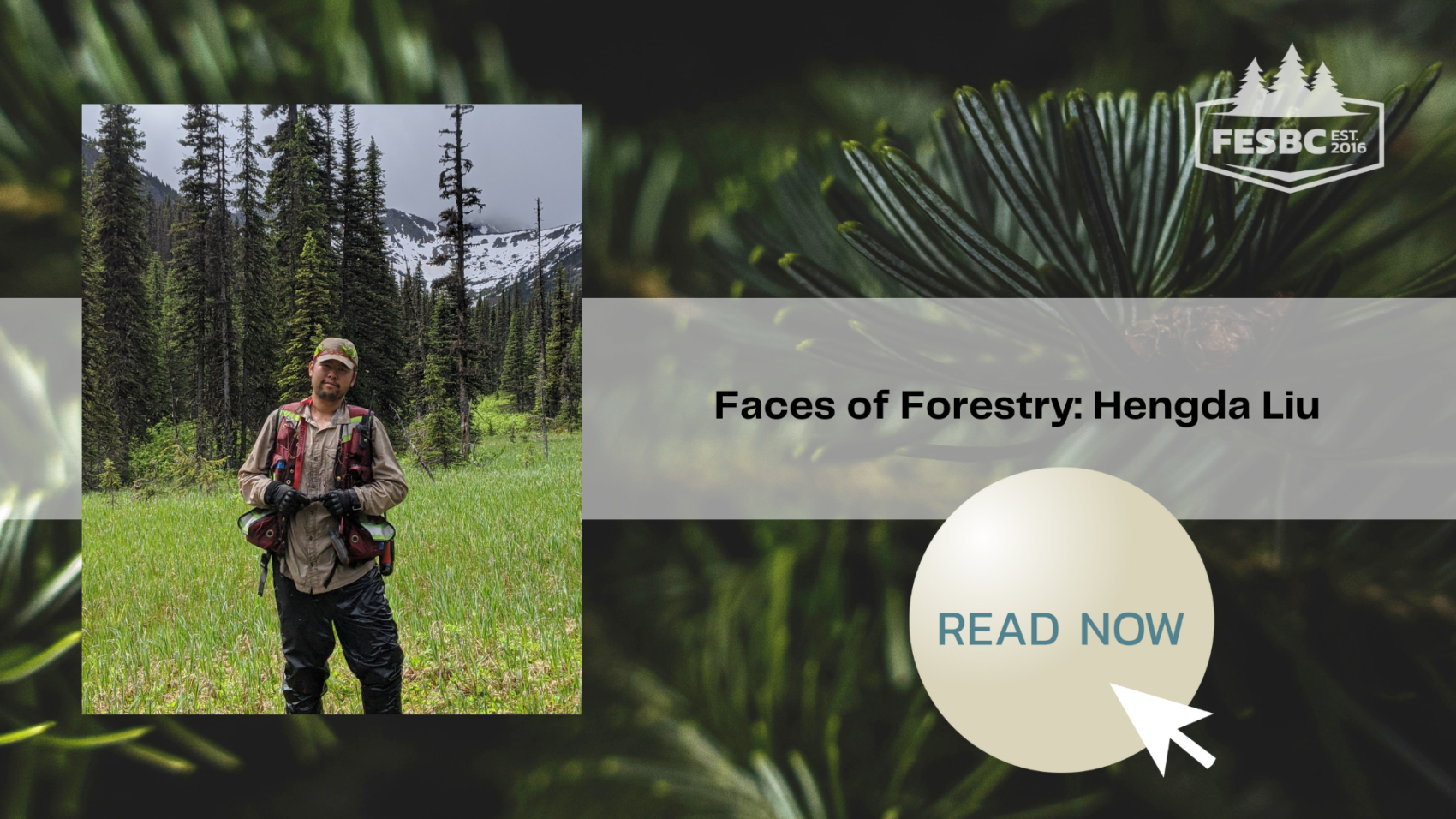
Faces of Forestry is an initiative of the Forest Enhancement Society of BC (FESBC) to highlight people doing great work to enhance our forests throughout British Columbia. This month, we feature Hengda Liu, Forestry Supervisor at Conifex, and founder of the University of Northern British Columbia (UNBC) Forestry Club Podcast, where, as a student, he had conversations about forestry with people across a wide range of experiences and perspectives.
Like many foresters, Hengda was initially drawn to the field for the chance to explore and work in remote wilderness areas, as well as the continuous learning opportunities it provided.
“I learned very quickly that forestry is a complex, multidisciplinary applied science. It’s a window for me to learn about the world – the trees, herbaceous plants, lichens, fungi, critters thriving in forest ecosystems, the land, people living on land, and their culture,” he said. “Additionally, it pushes me to learn how to find ways to work with people from diverse backgrounds, including those with strong opinions against professional forestry practices in B.C. I am growing as a person and a forester because of what I do at work.”
Hengda obtained a Diploma in Forestry Technician from Fleming College in Ontario back in 2019. Soon after, he moved to British Columbia and fell in love with everything about this province.
After working on layout and cruising for a couple of years, which involves planning and marking areas before forestry operations begin and measuring trees to estimate timber volume and quality, he decided to return to school. In May of 2025, he graduated from UNBC with a major in Forest Ecology and Management, and a minor in Biology and Conservation.
In his current role as Forestry Supervisor at Conifex, a forest products company that creates high-quality lumber products and renewable energy in Mackenzie, B.C., Hengda supervises multiphase contracts, road and cut-block permit applications, appraisals, and liaises with government agencies, Indigenous communities, and other key stakeholders.
“My days at work vary a lot depending on the focus of the day. I could be in the bush working with the field crew, in the office processing appraisal data, playing with a dozen software programs that my job requires me to master, or spending the entire day meeting with people,” he explained. “Every day is unique, fast-paced and never boring.”
As he further noted, keeping their commitments to Indigenous communities, stakeholders, and the public while ensuring blocks can be harvested safely and efficiently is a key aspect of his job.
“Forestry, especially in B.C., is an incredibly complex process before a block is harvested. Being a forester is a highly regulated profession in which we juggle multiple balls while balancing ourselves on a tight rope,” he added.
One of the things Hengda enjoys the most about his career is tackling complex challenges and learning new things, as well as leading and engaging in meaningful conversations. This passion for forestry education is evident through his podcast. During his time at UNBC, he created the ‘UNBC Forestry Club Podcast’ to help facilitate civil, constructive, and insightful conversations between very divided groups of people. Through this channel, he leads discussions on B.C.’s forests, climate change impacts, logging practices, biodiversity, conservation, as well as student experiences and stories. He is happy that the work of the podcast will continue with a new cohort of forestry students taking it on. Listen to the UNBC Forestry Club Podcast on Spotify or YouTube.
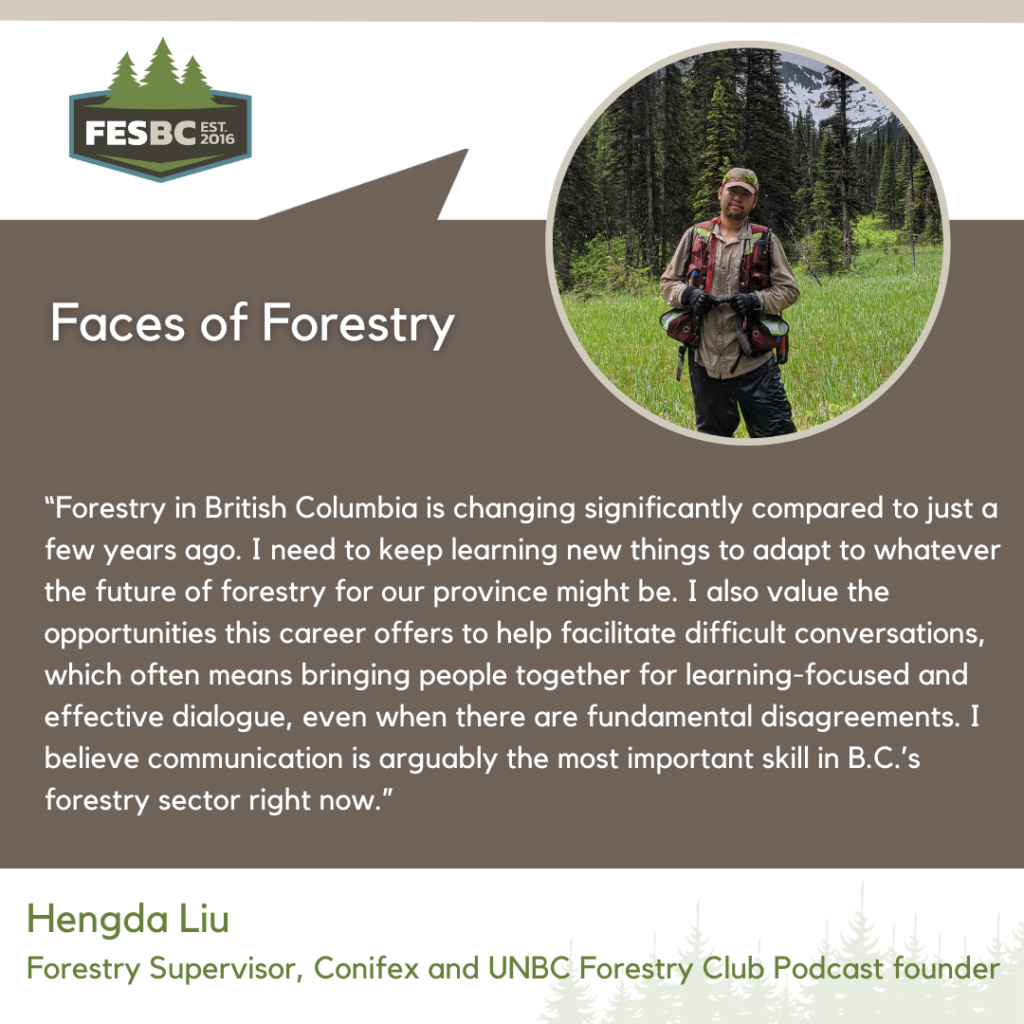
“Forestry in British Columbia is changing significantly compared to just a few years ago. I need to keep learning new things to adapt to whatever the future of forestry for our province might be,” he noted. “I also value the opportunities this career offers to help facilitate difficult conversations, which often means bringing people together for learning-focused and effective dialogue, even when there are fundamental disagreements. I believe communication is arguably the most important skill in B.C.’s forestry sector right now.”
Over the years, he has heard many stories from communities across the province about the significant role FESBC plays through its projects, which range from fibre utilization and wildlife habitat improvement to greenhouse gas management.
“While hosting the UNBC Forestry Club Podcast, I’ve had conversations with communities that have directly benefited from FESBC’s work. I am really glad and thankful that we have such an initiative like this to support forest management that matters to communities in B.C.”
Hengda believes experienced forest professionals must continue to engage with younger generations and encourage more people to join this challenging, complex, but rewarding profession. For him, a steady input of vibrant young leadership, innovation, and ideas is key to helping the industry adapt.
In addition, he believes that we need more accessible conversations about forestry. Looking ahead, he is excited to be working on a documentary series focused on B.C. forestry, covering planning, fieldwork, permitting, harvesting, milling, and silviculture.
“I found that forestry is a bit of a niche field, and I still have trouble explaining what I do at work to my family, who are outside of the forestry world. I hope that when people search for British Columbia’s forestry industry online, they find videos that explain what we do, the opportunities, and the challenges we face every day, and unfold this ‘mysterious’ forestry cycle to more people,” he said.
Thank you, Hengda, for your passion for forestry education and your commitment to thoughtful, inclusive dialogue and collaboration to support the future of forestry in British Columbia.